
NEGERI SEMBILAN ROYAL CRISIS REVEALS A SERIOUS VOID IN MALAYSIA’S CONSTITUTIONAL REMEDIES.
EMPOWERING THE FEDERAL COURT IS NOW ESSENTIAL
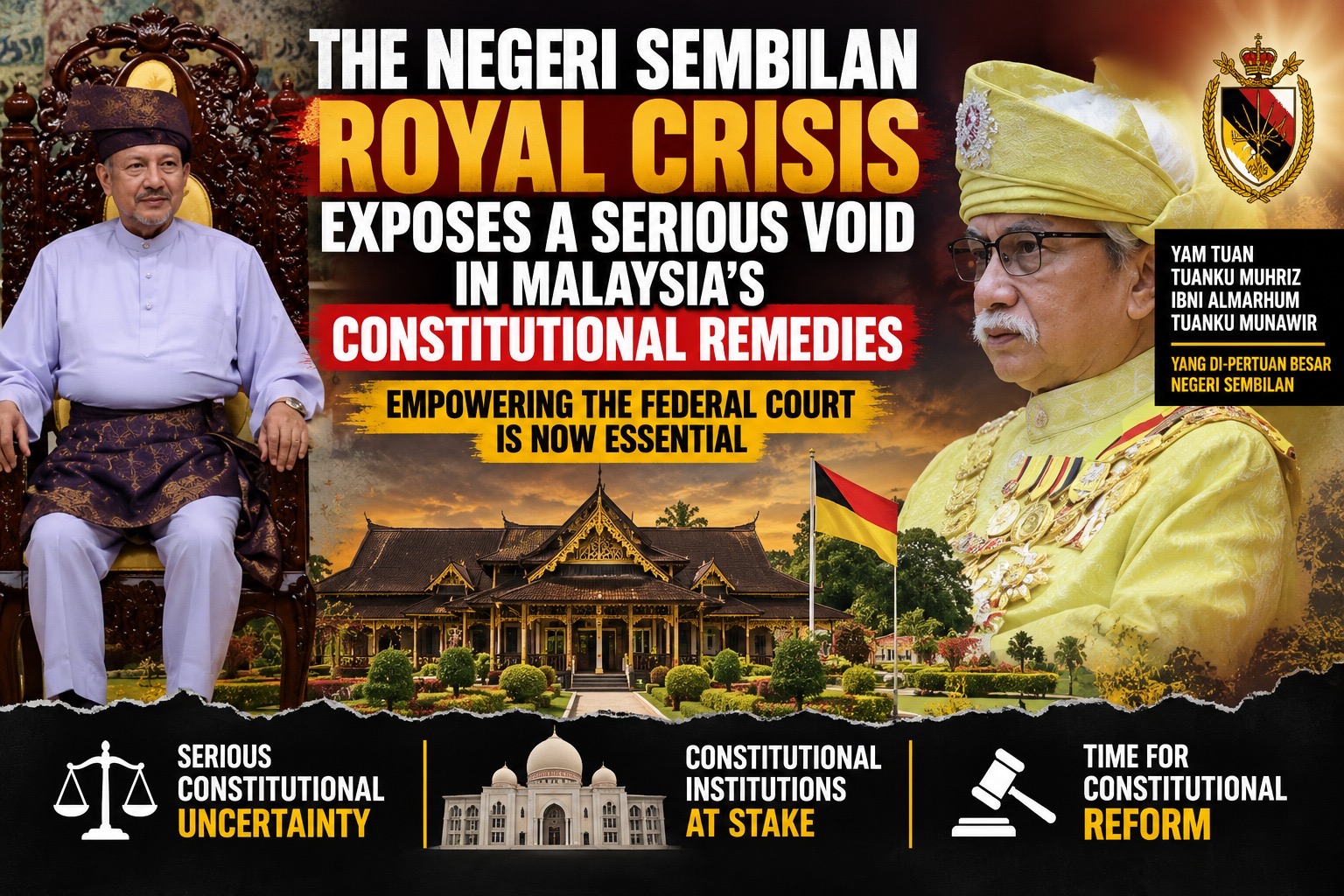
The constitutional crisis in Negeri Sembilan has brought to light a more fundamental issue which Malaysia can no longer ignore.
It therefore demands serious consideration of whether the Federal Court should be granted broader constitutional powers to act swiftly when a deadlock threatens the constitutional monarchy, government, or the rule of law.
There are now serious and competing constitutional claims concerning the very governance of Negeri Sembilan:
i) Was Article X complied with in the purported removal of the Yang di-Pertuan Besar?
ii) Can the four Undangs remove a Yang di-Pertuan Besar without first establishing the specific grounds and complying with the mandatory conditions prescribed by Article X?
iii) Was the subsequent installation of a new Yang di-Pertuan Besar constitutionally valid?
iv) Who are the lawful Undangs presently recognised under the Negeri Sembilan Constitution?
v) What is the constitutional validity of the disputed declaration endorsed by the Menteri Besar, who had earlier stated that his signature was obtained under duress?
vi) Was the removal of the ten members of the State Executive Council constitutionally valid?
These are not minor issues. They concern the identity and legitimate authority of the state’s key constitutional institutions.
This situation presents a significant constitutional challenge. While Article XXXIV(3) of the Laws of the Constitution of Negeri Sembilan, 1959 allows for constitutional questions to be referred for judicial opinion, this process may be stalled if the Undangs, who are essential to invoking it, are themselves involved in the dispute, divided, or have contested legal status.
The Negeri Sembilan Royal crisis, together with other serious constitutional challenges, exposes a significant gap in our present constitutional framework.
The Judiciary is not presently vested with sufficient jurisdictional authority to ensure that exceptional constitutional disputes can be brought before the courts and determined effectively and without undue delay.
DIRECT ACCESS TO CONSTITUTIONAL JUSTICE - THE INDIAN MODEL
India offers a particularly relevant example of direct constitutional access, even though its provisions have to be adapted—rather than simply transplanted—to Malaysia's own constitutional monarchy and federal system.
The Indian Supreme Court is given direct access to enforce fundamental rights according to Article 32 of the Indian Constitution, while Article 226 grants the High Courts a broader jurisdiction which goes beyond fundamental rights to include other legal rights.
The core principle is that the Federal Court should have sufficient powers to provide effective constitutional remedies, protect the rule of law, and maintain the separation of powers.
Malaysia can no longer afford to delay adopting its own version of that principle, carefully tailored to our constitutional monarchy, federal structure and system of government.
At present, the jurisdiction of our Federal Court is exercised principally through routes prescribed by the Federal Constitution, including its original and appellate jurisdiction, constitutional references, and the advisory jurisdiction under Article 130.
The Negeri Sembilan crisis, the constitutional challenge to Anwar Ibrahim’s eligibility to serve as Prime Minister, and the challenge to the constitutionality of the Malaysia-US ART Agreement illustrate the same deficiency.
Fundamental constitutional questions may become entangled in locus standi, strike-out applications, and lengthy procedural and appellate processes. By the time an authoritative answer is obtained, the constitutional damage sought to be prevented may already have occurred.
TWO DISTINCT REFORMS SHOULD BE CONSIDERED
Our country should consider two separate but complementary constitutional reforms.
A person with sufficient constitutional interest, a Ruler or another specified constitutional office-holder, should, in exceptional cases, be able to petition the Federal Court directly for the determination of a substantial constitutional question.
Such a mechanism could prevent fundamental constitutional questions from remaining unanswered simply because conventional rules of locus standi prevent an appropriate applicant from bringing the issue before the Court.
A Constitution should not fail to provide an answer simply because the identity of the person entitled to ask the question is part of the dispute.
Malaysia should consider conferring upon the Federal Court an expressly defined and exceptional suo motu constitutional jurisdiction.
It would enable the Federal Court, in prescribed circumstances, to act swiftly and provide a timely, authoritative resolution when an exceptional constitutional deadlock threatens constitutional government and ordinary judicial mechanisms have become ineffective or paralyzed. This would reinforce the separation of powers and ensure the rule of law prevails over constitutional impasse.
Direct constitutional access ensures that someone can bring an exceptional constitutional question before the Court.
This would not become an unrestricted power enabling courts to enter ordinary political controversies.
The jurisdiction could be confined to exceptional cases involving substantial questions concerning the existence, identity, authority or functioning of constitutional institutions, or other constitutional questions of comparable national or public importance requiring urgent determination.
The Federal Court should retain the power summarily to reject frivolous, political, hypothetical or abusive attempts to invoke that jurisdiction.
PARLIAMENT SHOULD CONSIDER CONSTITUTIONAL REFORM
Federal legislators should consider appropriateamendment to the Federal Constitution itself, particularly within the existing constitutional architecture governing judicial power and the Federal Court's jurisdiction.
The jurisdiction, threshold for intervention, persons entitled to invoke direct access, circumstances permitting suo motuintervention and safeguards against abuse should all be clearly defined.
The objective is not to expand judicial power for its own sake, but to ensure that the judiciary is adequately empowered to discharge its constitutional role, safeguard the rule of law and reinforce the separation of powers by ensuring that no constitutional deadlock is left beyond the reach of an authoritative judicial determination.
The Negeri Sembilan crisis should therefore become the catalyst for Parliament to examine and positively consider that Malaysia now requires both a carefully defined right of direct constitutional access and, for truly exceptional constitutional deadlocks, an express and limited suo motu jurisdiction for the Federal Court.
Waytha Moorthy Ponnusamy