
EMPOWERING THE FEDERAL COURT IS NOW ESSENTIAL
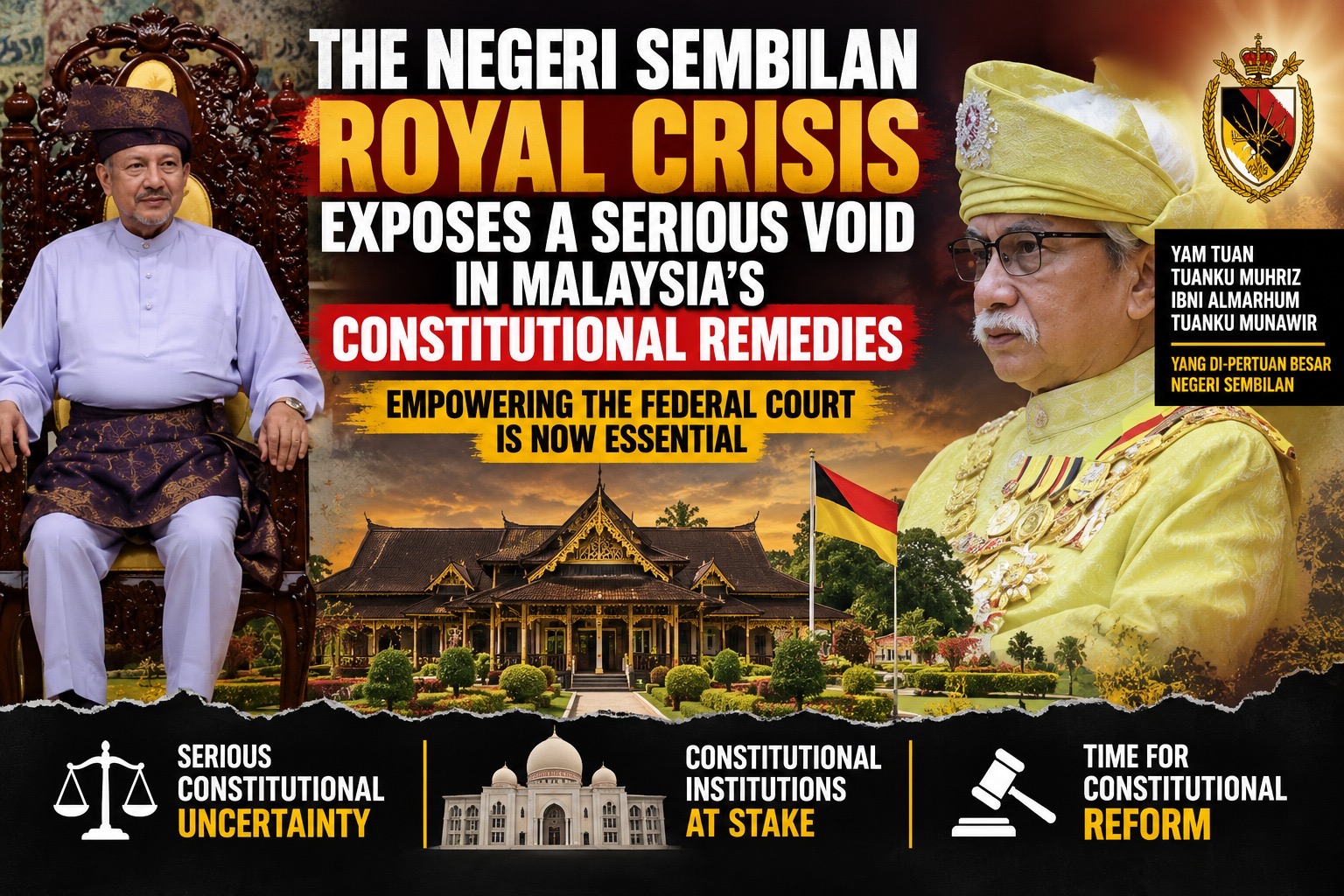
The constitutional crisis in Negeri Sembilan has brought to light a more fundamental issue which Malaysia can no longer ignore.
It therefore demands serious consideration of whether the Federal Court should be granted broader constitutional powers to act swiftly when a deadlock threatens the constitutional monarchy, government, or the rule of law.
There are now serious and competing constitutional claims concerning the very governance of Negeri Sembilan:
i) Was Article X complied with in the purported removal of the Yang di-Pertuan Besar?
ii) Can the four Undangs remove a Yang di-Pertuan Besar without first establishing the specific grounds and complying with the mandatory conditions prescribed by Article X?
iii) Was the subsequent installation of a new Yang di-Pertuan Besar constitutionally valid?
iv) Who are the lawful Undangs presently recognised under the Negeri Sembilan Constitution?
v) What is the constitutional validity of the disputed declaration endorsed by the Menteri Besar, who had earlier stated that his signature was obtained under duress?
vi) Was the removal of the ten members of the State Executive Council constitutionally valid?
These are not minor issues. They concern the identity and legitimate authority of the state’s key constitutional institutions.
This situation presents a significant constitutional challenge. While Article XXXIV(3) of the Laws of the Constitution of Negeri Sembilan, 1959 allows for constitutional questions to be referred for judicial opinion, this process may be stalled if the Undangs, who are essential to invoking it, are themselves involved in the dispute, divided, or have contested legal status.
The Negeri Sembilan Royal crisis, together with other serious constitutional challenges, exposes a significant gap in our present constitutional framework.
The Judiciary is not presently vested with sufficient jurisdictional authority to ensure that exceptional constitutional disputes can be brought before the courts and determined effectively and without undue delay.
DIRECT ACCESS TO CONSTITUTIONAL JUSTICE - THE INDIAN MODEL
India offers a particularly relevant example of direct constitutional access, even though its provisions have to be adapted—rather than simply transplanted—to Malaysia's own constitutional monarchy and federal system.
The Indian Supreme Court is given direct access to enforce fundamental rights according to Article 32 of the Indian Constitution, while Article 226 grants the High Courts a broader jurisdiction which goes beyond fundamental rights to include other legal rights.
The core principle is that the Federal Court should have sufficient powers to provide effective constitutional remedies, protect the rule of law, and maintain the separation of powers.
Malaysia can no longer afford to delay adopting its own version of that principle, carefully tailored to our constitutional monarchy, federal structure and system of government.
At present, the jurisdiction of our Federal Court is exercised principally through routes prescribed by the Federal Constitution, including its original and appellate jurisdiction, constitutional references, and the advisory jurisdiction under Article 130.
The Negeri Sembilan crisis, the constitutional challenge to Anwar Ibrahim’s eligibility to serve as Prime Minister, and the challenge to the constitutionality of the Malaysia-US ART Agreement illustrate the same deficiency.
Fundamental constitutional questions may become entangled in locus standi, strike-out applications, and lengthy procedural and appellate processes. By the time an authoritative answer is obtained, the constitutional damage sought to be prevented may already have occurred.
TWO DISTINCT REFORMS SHOULD BE CONSIDERED
Our country should consider two separate but complementary constitutional reforms.
A person with sufficient constitutional interest, a Ruler or another specified constitutional office-holder, should, in exceptional cases, be able to petition the Federal Court directly for the determination of a substantial constitutional question.
Such a mechanism could prevent fundamental constitutional questions from remaining unanswered simply because conventional rules of locus standi prevent an appropriate applicant from bringing the issue before the Court.
A Constitution should not fail to provide an answer simply because the identity of the person entitled to ask the question is part of the dispute.
Malaysia should consider conferring upon the Federal Court an expressly defined and exceptional suo motu constitutional jurisdiction.
It would enable the Federal Court, in prescribed circumstances, to act swiftly and provide a timely, authoritative resolution when an exceptional constitutional deadlock threatens constitutional government and ordinary judicial mechanisms have become ineffective or paralyzed. This would reinforce the separation of powers and ensure the rule of law prevails over constitutional impasse.
Direct constitutional access ensures that someone can bring an exceptional constitutional question before the Court.
This would not become an unrestricted power enabling courts to enter ordinary political controversies.
The jurisdiction could be confined to exceptional cases involving substantial questions concerning the existence, identity, authority or functioning of constitutional institutions, or other constitutional questions of comparable national or public importance requiring urgent determination.
The Federal Court should retain the power summarily to reject frivolous, political, hypothetical or abusive attempts to invoke that jurisdiction.
PARLIAMENT SHOULD CONSIDER CONSTITUTIONAL REFORM
Federal legislators should consider appropriateamendment to the Federal Constitution itself, particularly within the existing constitutional architecture governing judicial power and the Federal Court's jurisdiction.
The jurisdiction, threshold for intervention, persons entitled to invoke direct access, circumstances permitting suo motuintervention and safeguards against abuse should all be clearly defined.
The objective is not to expand judicial power for its own sake, but to ensure that the judiciary is adequately empowered to discharge its constitutional role, safeguard the rule of law and reinforce the separation of powers by ensuring that no constitutional deadlock is left beyond the reach of an authoritative judicial determination.
The Negeri Sembilan crisis should therefore become the catalyst for Parliament to examine and positively consider that Malaysia now requires both a carefully defined right of direct constitutional access and, for truly exceptional constitutional deadlocks, an express and limited suo motu jurisdiction for the Federal Court.
Waytha Moorthy Ponnusamy
Perdana Menteri Anwar Ibrahim mesti menjelaskan apakah asas yang munasabah untuk beliau meletakkan nyawa dan keselamatan pelarian Rohingya di tangan sebuah pentadbiran yang diketuai oleh Presiden Min Aung Hlaing — panglima tentera yang sama, di bawah kepimpinannya, orang Rohingya mengalami pembunuhan beramai-ramai, rogol, pembakaran kampung-kampung mereka dan pengusiran secara paksa dari Myanmar.
Lebih membimbangkan ialah kegagalan nyata Kerajaan Malaysia untuk terlebih dahulu mendapatkan penglibatan bermakna Pertubuhan Bangsa-Bangsa Bersatu (PBB) dan UNHCR, serta mengambil kira dapatan-dapatan meluas dan berterusan oleh PBB dan pertubuhan hak asasi manusia antarabangsa mengenai keadaan yang bakal dihadapi oleh orang Rohingya di Myanmar.
Kegagalan PM Anwar ini merupakan suatu pertaruhan berbahaya terhadap nyawa sebuah masyarakat yang telah lama dianiaya.
Min Aung Hlaing bukanlah seorang ketua kerajaan biasa yang dengannya Malaysia sedang merundingkan suatu proses penghantaran pulang yang rutin.
Beliau merupakan Panglima Tertinggi Angkatan Tentera Myanmar ketika pihak tentera melaksanakan pembersihan etnik yang kejam terhadap Rohingya pada tahun 2017. Penyiasat Pertubuhan Bangsa-Bangsa Bersatu mendokumentasikan pembunuhan beramai-ramai, rogol dan keganasan seksual, pemusnahan kampung-kampung Rohingya serta tindakan yang memaksa lebih 700,000 Rohingya melarikan diri dari Myanmar. Penyiasat PBB kemudiannya menggesa agar Min Aung Hlaing dan jeneral-jeneral kanan lain disiasat dan didakwa atas genosid, jenayah terhadap kemanusiaan dan jenayah perang.
Pendakwa Mahkamah Jenayah Antarabangsa (ICC) telah memohon suatu waran tangkap terhadap Min Aung Hlaing, dengan menyatakan bahawa terdapat alasan yang munasabah untuk mempercayai bahawa beliau memikul tanggungjawab jenayah bagi jenayah terhadap kemanusiaan.
Secara berasingan, pada Februari 2025, sebuah mahkamah persekutuan Argentina yang melaksanakan bidang kuasa sejagat telah memerintahkan waran tangkap antarabangsa terhadap Min Aung Hlaing dan pegawai-pegawai tentera lain dalam prosiding berhubung dakwaan genosid dan jenayah terhadap kemanusiaan terhadap Rohingya.
Dengan latar belakang tersebut, apakah asas rasional PM Anwar untuk berurusan dengan Min Aung Hlaing dan bergantung pada jaminan daripada kepimpinan junta tentera yang sama yang dituduh melakukan pembersihan etnik terhadap masyarakat yang kini dicadangkannya untuk dihantar pulang?
Dalam laporan terkininya bertarikh 25 Ogos 2026, Pesuruhjaya Tinggi PBB bagi Hak Asasi Manusia merumuskan bahawa, memandangkan keadaan di Negeri Rakhine mengalami “kemerosotan selanjutnya”, keadaan masih “tidak kondusif bagi kepulangan yang selamat, mampan dan bermaruah”. Namun Anwar kini mencadangkan kepulangan sedemikian. Apakah bukti bebas yang dimiliki oleh Perdana Menteri sehingga membolehkan beliau mengetepikan penilaian PBB yang begitu jelas dan terkini ini?
Amnesty International turut memberi amaran bahawa keadaan sedia ada di utara Negeri Rakhine masih jauh daripada sesuai untuk kepulangan Rohingya secara selamat dan bahawa penghantaran pulang yang dilakukan terlalu awal boleh membawa akibat yang amat dahsyat.
Adakah Anwar telah meneliti laporan-laporan ini sebelum memutuskan bahawa Malaysia harus meneruskan penghantaran pulang ribuan Rohingya?
PM Anwar hendaklah menghentikan sebarang penghantaran pulang sehingga perlindungan antarabangsa yang bebas ini diwujudkan, serta mendapatkan penglibatan PBB dan Amnesty International sebelum mempertimbangkan untuk menghantar pulang pelarian-pelarian tersebut.
Ini bukanlah suatu perkara di mana kepentingan politik boleh mengatasi nyawa manusia.
Waytha Moorthy Ponnusamy
Presiden
Malaysian Advancement Party
17.9.2026
Prime Minister Anwar Ibrahim must explain what conceivable basis he has for placing the lives and safety of Rohingya refugees in the hands of an administration headed by President Min Aung Hlaing — the very military commander under whose leadership the Rohingya suffered mass killings, rape, the burning of their villages and forced displacement from Myanmar.
Even more disturbing is the apparent failure of the Malaysian Government to first secure the meaningful participation of the United Nations and UNHCR, and to confront the extensive and continuing findings of the UN and international human-rights organisations on the conditions awaiting Rohingya in Myanmar.
PM Anwar’s failure is a dangerous gamble with the lives of a persecuted people.
Min Aung Hlaing is not an ordinary head of government with whom Malaysia is negotiating a routine repatriation exercise.
He was Commander-in-Chief of the Myanmar Armed Forces when the military conducted its brutal 2017 ethnic cleansing against the Rohingya. United Nations investigators documented mass killings, rape and sexual violence, the destruction of Rohingya villages and the forced fleeing of more than 700,000 Rohingya from Myanmar. UN investigators subsequently called for Min Aung Hlaing and other senior generals to be investigated and prosecuted for genocide, crimes against humanity and war crimes.
The International Criminal Court Prosecutor has applied for a warrant of arrest for Min Aung Hlaing's arrest, stating that there are reasonable grounds to believe that he bears criminal responsibility for the crimes against humanity.
Separately, in February 2025, an Argentine federal court exercising universal jurisdiction ordered international arrest warrants against Min Aung Hlaing and other army officials in proceedings concerning alleged genocide and crimes against humanity against the Rohingya.
Against that background, what rational basis does PM Anwar have on dealing with Min Aung Hlaing and for relying upon assurances from the very military junta leadership accused of the ethnic cleansing of the people he now proposes to return?
In its latest report of 25 August 2026, the UN High Commissioner for Human Rights concluded that, given the ‘further deteriorations’ in Rakhine State, conditions remain ‘non-conducive for safe, sustainable, and dignified returns’. Yet Anwar now proposes precisely such a return. What independent evidence does the Prime Minister possess that entitles him to disregard this stark and recent UN assessment?”
Amnesty International has similarly warned that existing conditions in northern Rakhine State are nowhere near ready for the safe return of the Rohingya and that premature repatriation could have catastrophic consequences.
Has Anwar considered these reports before deciding that Malaysia should proceed with the return of thousands of Rohingya?
Anwar should therefore halt any repatriation until these independent international safeguards are in place and engage the UN and Amnesty International before he considers sending those refugees back.
This is not a matter where political expediency can take precedence over human life.
Waytha Moorthy Ponnusamy
President
Malaysian Advancement Party
17.9.2026
More Articles …
Page 2 of 33