
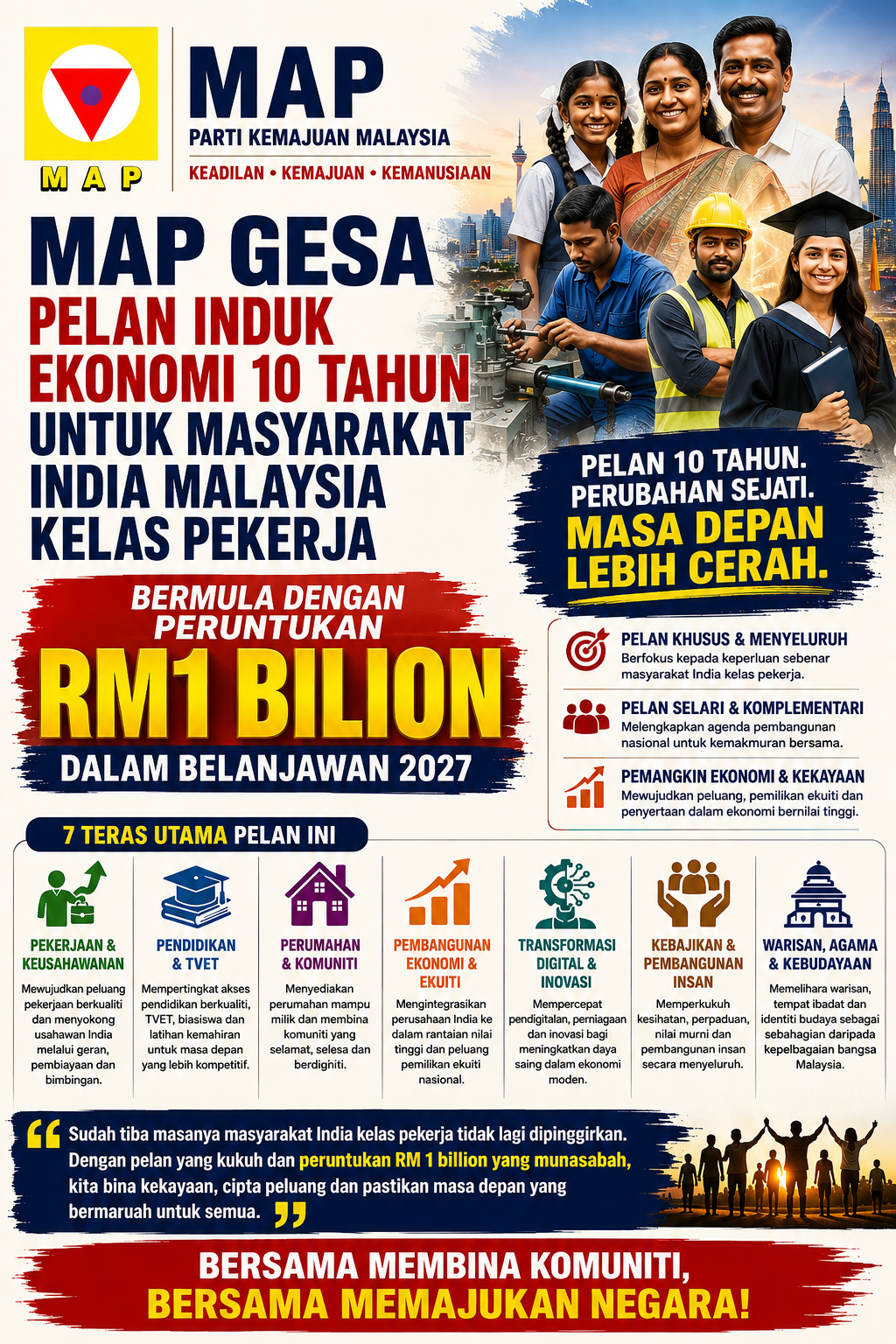
Parti Kemajuan Malaysia (MAP) menggesa Kerajaan Persekutuan melaksanakan sebuah Pelan Induk Ekonomi 10 Tahun yang khusus, menyeluruh dan berteraskan keperluan masyarakat India kelas pekerja, bermula serta-merta dengan peruntukan asas khas sebanyak RM1 bilion dalam Belanjawan 2027 yang akan dibentangkan pada bulan Oktober ini.
MAP berpendirian bahawa usaha mencapai mobiliti sosioekonomi yang tulen dan berkekalan bagi masyarakat India Malaysia kelas pekerja memerlukan perubahan daripada pendekatan jangka pendek kepada satu kerangka makroekonomi yang mampan dan berjangka panjang.
Selama lebih dua dekad, Perdana Menteri telah berkempen dengan pelbagai janji untuk meningkatkan taraf hidup masyarakat India sebagai komuniti minoriti di negara ini. Namun begitu, Rancangan Malaysia Ke-13 (RMK-13) telah gagal menyediakan sebarang pelan sosioekonomi khusus atau pelan hala tuju yang disasarkan kepada masyarakat India kelas pekerja. Akibatnya, komuniti ini terus terdedah kepada kitaran kerentanan antara generasi tanpa sebarang mekanisme pembangunan yang tersusun. Oleh yang demikian, MAP berpendirian bahawa sebuah Pelan Induk Ekonomi 10 Tahun yang berasingan dan khusus kini merupakan satu keperluan mutlak bagi menyelamatkan komuniti ini daripada terus dipinggirkan daripada arus perdana pembangunan ekonomi negara.
Model ekonomi semasa kerajaan masih melihat trauma sistemik yang dialami oleh kira-kira 800,000 bekas pekerja ladang yang telah terpinggir secara sejarah sebagai isu sampingan. Kerajaan terus bergantung kepada skim pinjaman mikro seperti Tekun Nasional (SPUMI) dan Amanah Ikhtiar Malaysia (AIM) untuk menangani ketidakseimbangan ekonomi yang bersifat struktural dan makro. Pendekatan ini tidak memadai untuk menyelesaikan masalah yang berakar umbi.
Keadaan ini ibarat memberikan seseorang sebuah penyodok kecil untuk membina sebuah rumah sedangkan apa yang diperlukan ialah akses kepada peralatan korporat dan peluang ekonomi sebenar untuk berjaya.
MAP mengiktiraf, menghormati dan menyokong sepenuhnya keperluan nasional untuk melaksanakan agenda-agenda ekonomi utama seperti Pelan Transformasi Ekonomi Bumiputera (PuTERA35) bagi memperkasakan masyarakat majoriti. Namun demikian, MAP menegaskan bahawa masyarakat India kelas pekerja juga memerlukan sebuah Pelan Induk Ekonomi 10 Tahun yang selari, khusus dan disesuaikan dengan realiti cabaran yang mereka hadapi. Pelan ini hendaklah disokong oleh peruntukan minimum RM1 bilion setahun sebagai asas kepada model pemerkasaan ekonomi yang benar-benar substantif dan mampu membawa perubahan struktur yang besar.
Masalah sebenar yang dihadapi oleh masyarakat India kelas pekerja ialah mereka hampir sepenuhnya terpinggir daripada peluang-peluang pembinaan kekayaan berskala besar dan pemilikan korporat negara. Walaupun skim pembiayaan mikro seperti Tekun Nasional dan Amanah Ikhtiar Malaysia menawarkan bantuan kredit jangka pendek yang berguna, masyarakat India kelas pekerja tidak boleh mencapai mobiliti ekonomi yang mapan hanya melalui hutang semata-mata.
Jika komuniti ini benar-benar mahu menikmati hasil pembangunan negara secara adil, maka tumpuan mesti beralih kepada mekanisme penciptaan kekayaan yang mampan. Ini bermaksud perusahaan milik masyarakat India perlu diintegrasikan ke dalam platform ekonomi bernilai tinggi, rantaian perolehan korporat, peluang pemilikan ekuiti dan sektor-sektor strategik ekonomi negara supaya mereka dapat membina kekayaan yang sebenar bersama rakyat Malaysia yang lain.
Sehubungan itu, MAP menggesa Belanjawan 2027 supaya melangkaui pendekatan simbolik dan bantuan bersifat kosmetik. Kami menyeru penubuhan Dana Pembangunan Tahunan RM1 Bilion sebagai langkah asas pertama kepada Pelan Induk Ekonomi 10 Tahun yang dicadangkan. Peruntukan khas ini amat penting bagi membolehkan masyarakat India kelas pekerja beralih daripada pergantungan kepada hutang mikro kepada penyertaan langsung dalam penciptaan kekayaan berskala besar, peluang perolehan korporat dan pembangunan infrastruktur TVET yang kukuh.
Inisiatif ini direka untuk melengkapkan agenda pembangunan nasional yang sedia ada. Matlamatnya adalah untuk memastikan bahawa apabila negara terus maju ke hadapan, masyarakat India kelas pekerja turut berkembang sebagai rakan pembangunan yang produktif, berdikari dan berkongsi kemakmuran negara secara saksama bersama seluruh rakyat Malaysia.
Waytha Moorthy Ponnusamy
Presiden
Parti Kemajuan Malaysia (MAP)
19.8.2026
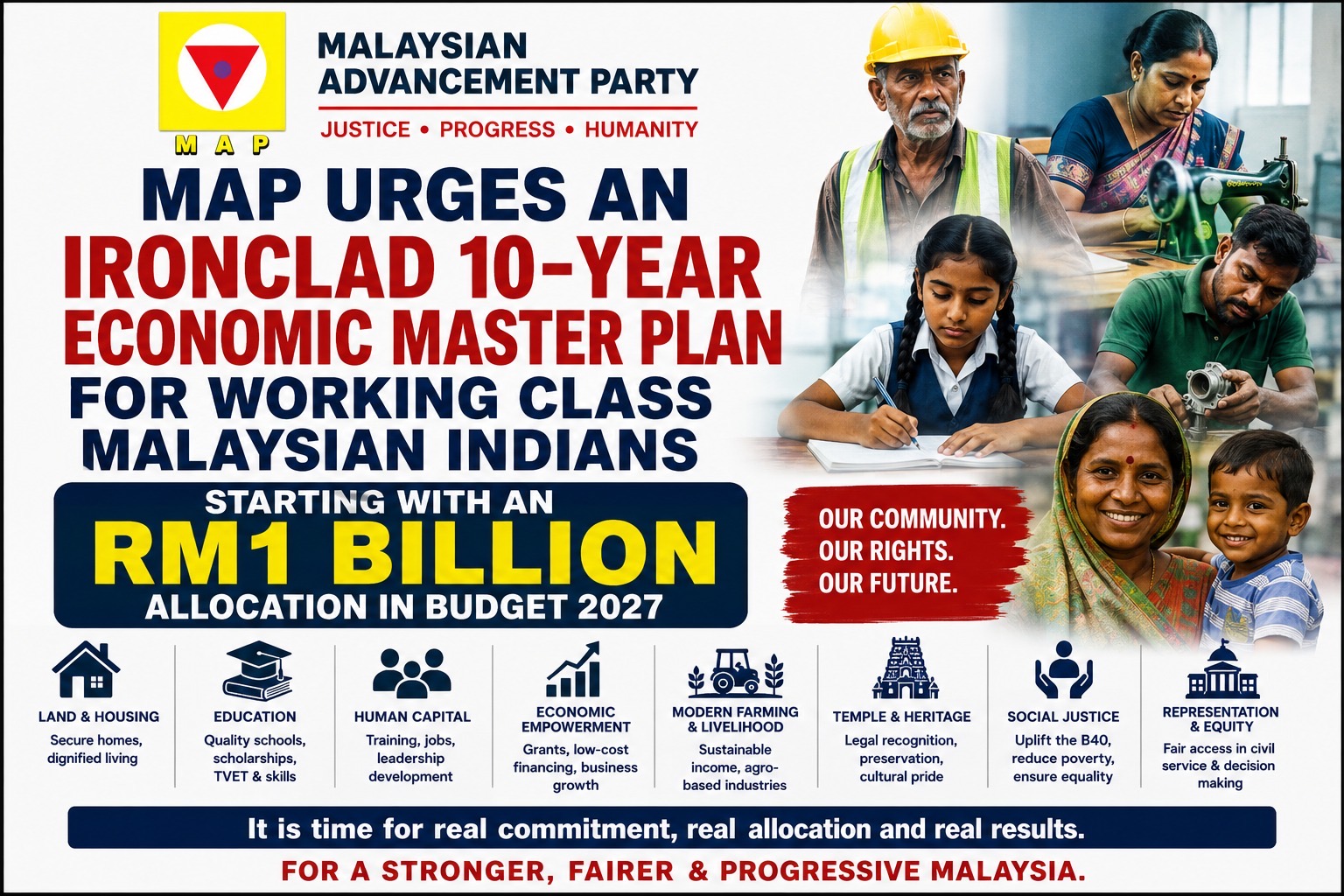
The Malaysian Advancement Party (MAP) urges the federal government to implement an ironclad, 10-year tailor-made Economic Master Plan for the working-class Indian community, commencing immediately with a dedicated RM1 billion foundational allocation in the upcoming Budget 2027 this October.
MAP maintains that achieving genuine, long-term socio-economic upward mobility for working-class Malaysian Indians requires moving beyond short-term fixes toward a sustainable macroeconomic framework.
For over twenty years, the Prime Minister has campaigned on promises of uplifting the minority Indian community. Yet, the 13th Malaysia Plan (13MP) leaves working-class Indians entirely exposed to generational vulnerability by completely omitting any dedicated socio-economic plan or targeted roadmap for the community. MAP thus maintains that a separate, dedicated 10-year Economic Master Plan is now absolutely mandatory to rescue the community from being totally shut out of the national budget and another decade of economic standstill.
The government's current economic model treats the systemic trauma of 800,000 historically displaced estate workers as an afterthought, relying on minor microcredit loan schemes such as Tekun Nasional (SPUMI) and Amanah Ikhtiar Malaysia (AIM) to address macroeconomic disparities.
This is akin to handing someone a tiny shovel to build a house rather than giving them the real corporate tools to succeed.
While MAP fully recognises, respects, and supports the vital national necessity of robust economic agendas such as the Bumiputera Economic Transformation Plan (PuTERA35) to uplift the majority community, we firmly maintain that the working-class Indian community urgently requires a parallel, 10-year, tailor-made Economic Master Plan. This plan must be backed by a minimum allocation of RM1 billion per annum to serve as a truly substantive, game-changing model of structural economic empowerment.
The real problem is that our community is completely locked out of the country's big wealth-building opportunities and corporate ownership. While existing micro-financing schemes like Tekun Nasional and Amanah Ikhtiar Malaysia (AIM) offer helpful short-term credit solutions, working-class Indians cannot achieve long-term, resilient economic upward mobility through debt alone. For our community to truly share in the fruits of the nation's development, we need a shift toward sustainable wealth-creation mechanisms. This means moving beyond basic micro-loans to integrate Indian-owned enterprises into higher-value economic platforms, ensuring we build genuine equity alongside our fellow Malaysians."
MAP demands that Budget 2027 move past token gestures. We urge an ironclad annual development fund of RM1 Billion as the foundational first step of our proposed 10-year master plan. This dedicated allocation is vital for transitioning working-class Indians away from small micro-debts and integrating them directly into large-scale wealth creation, corporate procurement opportunities, and robust TVET infrastructure.
The real problem is that our community is completely locked out of the country's big wealth-building opportunities and corporate ownership.
This initiative is designed to fully complement national development agendas, ensuring that as our nation advances, the working-class Indian community grows alongside our fellow Malaysians as productive, self-reliant partners in shared prosperity.
Waytha Moorthy Ponnusamy
President
Malaysian Advancement Party (MAP)
DAP akan membuat keputusan pada 16 Ogos sama ada untuk kekal atau meninggalkan Kerajaan Perpaduan.
Selama bertahun-tahun, Anwar Ibrahim meminta rakyat Malaysia mempercayai bahawa apabila Pakatan Harapan berjaya sampai ke Putrajaya, negara ini akan menyaksikan reformasi institusi, akauntabiliti, tadbir urus yang baik serta berakhirnya budaya politik yang telah mereka kecam selama berdekad-dekad.
Harapan rakyat terhadap PH begitu tinggi kerana ia dibina atas janji-janji yang dibuat kepada rakyat selama hampir 20 tahun.
Sekiranya DAP akhirnya memutuskan untuk meninggalkan Kerajaan Perpaduan kerana reformasi yang bermakna tidak dapat dilaksanakan, DAP tidak seharusnya sekadar melepaskan jawatan-jawatan Menteri mereka dan berlalu begitu sahaja. Setelah lebih tiga tahun berada di tengah-tengah pentadbiran kerajaan dan memegang kuasa, DAP bertanggungjawapmemberikan satu penjelasan yang penuh dan jujur tentang apa sebenarnya yang telah berlaku kepada agenda Reformasi Anwar.
Reformasi apakah yang telah diperjuangkan oleh DAP?
Yang manakah telah ditolak, ditangguhkan, dicairkan atau ditinggalkan?
Apakah yang menghalangnya?
Adakah reformasi tersebut digagalkan oleh tentangan politik, kepentingan yang bersaing atau parti-parti lain dalam Kerajaan Perpaduan?
Dan sekiranya kompromi terpaksa dibuat demi mengekalkan kestabilan Kerajaan Perpaduan, DAP harus menjelaskan apakah kompromi-kompromi tersebut dan mengapa ia dianggap perlu.
Ini bukan soal menyalahkan DAP atas kegagalan Reformasi. Ini adalah soal meminta DAP, sebagai sebuah parti utama yang berada dalam kerajaan dan Kabinet, untuk memberitahu rakyat Malaysia perkara yang sebenarnya.
Namun, terdapat satu persoalan yang lebih besar yang tidak boleh dielakkan.
Anwar Ibrahim membina perjuangan politiknya berteraskan Reformasi. Selama lebih dua dekad, rakyat Malaysia turun ke jalan raya, berkorban, mengundi dan berdiri bersamanya kerana mereka percaya bahawa sekiranya beliau suatu hari menjadi Perdana Menteri, reformasi yang diperjuangkannya akhirnya akan menjadi kenyataan.
Dan apakah yang telah terjadi kepada Reformasi yang dijanjikan itu selain Anwar berulang kali melaungkan perkataan “sakau”?
Di manakah perubahan institusi yang sebenar?
a. Azam Baki terus kekal menerajui SPRM dan tempoh perkhidmatannya telah dilanjutkan sebanyak dua kali.
b. Blogger, pengulas media sosial, aktivis mahasiswa dan pembela hak asasi manusia terus berdepan siasatan, soal siasat dan tindakan penguatkuasaan kerana pandangan yang mereka suarakan dalam talian. Pada masa yang sama, Seksyen 233 Akta Komunikasi dan Multimedia terus memberikan kesan menakutkan terhadap kebebasan bersuara. Peruntukan yang pernah dikecam ketika PH berada dalam pembangkang tidak boleh tiba-tiba dianggap boleh diterima hanya kerana PH kini berkuasa.
c. Kebebasan badan kehakiman, yang merupakan benteng terakhir keadilan, juga tidak terlepas daripada persoalan serius di bawah kerajaan ini. Tindakan Anwar melantik bekas PeguamNegaranya, Ahmad Terrirudin Salleh, secara terus ke Mahkamah Persekutuan, diikuti dengan pelantikannya ke Suruhanjaya Pelantikan Kehakiman walaupun terdapat hakim-hakim Mahkamah Persekutuan yang lebih kanan, serta dakwaan bahawa Terrirudin telah campur tangan dalam badan kehakiman, telah mencetuskan kebimbangan awam yang munasabah mengenai ketelusan dan kebebasan proses pelantikan kehakiman serta sama ada Anwar cenderung untuk melantik “orang-orangnya” dalam badan kehakiman.
d. Akta Perolehan Kerajaan 2025, yang dipromosikan sebagai satu reformasi besar bagi membanteras rasuah, sebaliknya mengekalkan kuasa yang luas kepada Menteri untuk meluluskan perolehan dan memberikan pengecualian. Ini menyebabkan perbelanjaan awam bernilai berbilion ringgit terus terdedah kepada budi bicara politik dan bukannya penelitian yang benar-benar bebas, sekali gus menimbulkan persoalan sama ada Anwar secara senyap membenarkan budaya “sakau” terus hidup dalam sistem.
e. Politik ketakutan berasaskan kaum, sikap tidak menghormatikepercayaan agama dan perpecahan masyarakat terus meracuni wacana nasional secara berbahaya, sementara ahli-ahli politik dan golongan ekstremis terus mengeksploitasi isu kaum dan agama demi kepentingan politik. Anwar sendiri turut mempunyai peranan dalam menyumbang kepada kebencian berasaskan kaum dan agama apabila beliau gagal menangani pelbagai isu dengan sewajarnya.
f. Tiada usaha yang serius, praktikal dan berterusan untuk merangka serta melaksanakan pelan sosioekonomi jangka panjang bagi menangani ketertinggalan yang telah berakar umbi serta kemiskinan unik yang dihadapi oleh masyarakat minoriti India dan Orang Asli di Malaysia.
g. Kematian dalam tahanan serta kejadian tembakan misteri terhadap suspek terus menghantui negara. Dalam kes tembakan polis di Durian Tunggal, satu rakaman audio menunjukkan bahawa tiga lelaki tersebut ditembak mati dari jarak dekat, dengan salah seorang mangsa kedengaran merayu agar nyawanya diselamatkan sebelum ditembak mati.
h. Keadilan untuk Teoh Beng Hock masih belum tercapai selepas 17 tahun, tanpa sebarang tindakan terhadap mereka yang bertanggungjawab.
i. Seorang pegawai tribunal Kastam ditemui mati dengan leher dan kakinya diikat menggunakan pengikat kabel (cable ties) di bangunan Kementerian Kewangan, namun polis mengklasifikasikan kes tersebut sebagai mati mengejut dan menolak kemungkinan berlakunya perbuatan khianat.
j. Pamela Ling hilang pada siang hari ketika dilaporkan dalam perjalanan ke Ibu Pejabat SPRM dan sehingga kini masih belum ditemui.
k. Di manakah reformasi yang akan memastikan SPRM, agensi-agensi penguatkuasaan dan GLC benar-benar bertanggungjawab kepada rakyat?
l. Sebaliknya, rakyat biasa dan golongan perniagaan dibebankan dengan pelbagai langkah seperti e-Invois, sedangkan persoalan-persoalan asas mengenai perbelanjaan awam dan akauntabiliti masih belum terjawab.
Semua reformasi ini bukannya sesuatu yang mustahil sehingga memerlukan satu revolusi. Kebanyakannya hanya memerlukan kemahuan politik, perundangan, ketelusan serta keberanian untuk menggunakan kuasa besar yang telah pun diamanahkan oleh rakyat kepada kerajaan ini.
Justeru, DAP mesti memberitahu rakyat Malaysia: adakah Reformasi telah disekat oleh pihak lain dalam Kerajaan Perpaduan, dikompromikan demi mempertahankan kuasa Anwar, atau ditinggalkan begitu sahaja setelah kuasa berjaya diperoleh?
Waytha Moorthy Ponnusamy
Presiden
Malaysian Advancement Party (MAP)
11 Ogos 2026
More Articles …
Page 4 of 33